



I didn’t think I’d be here again. Not after 90 days.
Not after I earned my 60-day chip and started leading check-ins. Not after I told my sister, “This time, it’s different.” And definitely not after I wrote a post about how a partial hospitalization program saved my life.
But I relapsed.
It wasn’t dramatic. There wasn’t a wild night or some huge crash. It was one drink at a work thing. Then another after a fight. Then a week later, I was canceling meetings, avoiding phone calls, waking up sick, and pretending nothing was wrong. The spiral was quiet—but fast.
And the shame hit harder than the substance ever did.
I Was More Afraid of What People Would Think Than What I’d Done
Relapse isn’t just using again—it’s losing face in a space where you were doing well. I didn’t want to tell my sponsor. I didn’t want to see anyone from group. I felt like I’d broken some unspoken rule: if you get better, stay better. Don’t come back looking like a cautionary tale.
I was terrified people would think I’d lied. That I didn’t try hard enough. That maybe I never really got it.
But the truth? I did get it. I just… lost grip for a minute. And that minute became a week. Then two.
By the time I admitted what happened, I was less afraid of being judged and more afraid I’d disappear if I didn’t say something.
Saying Yes to a Partial Hospitalization Program Again Felt Like Swallowing My Pride
When a friend from treatment gently suggested PHP, I wanted to brush it off.
“I’ve already done that level of care.”
“I know the tools. I just need to use them.”
“I can figure this out on my own.”
I thought PHP was for people who had never tried before. People who needed to start recovery. I didn’t want to be back in that seat again, re-introducing myself like I was new here.
But the truth was—I was new here. Because this wasn’t day one again. This was day one after knowing what day 90 felt like. And that’s a different kind of pain.
Eventually, I said yes. Not because I felt strong, but because I didn’t trust myself to stay safe alone.
The Second Time in PHP Was Nothing Like the First—In the Best Way
When I returned to PHP at Southeast Addiction TN, I expected to feel like a failure. I expected the intake process to sting, to sit across from a therapist who would gently ask, “So, what happened?”
But what I got was this: “We’re glad you came back. Let’s meet you where you are.”
That was the start of my healing—not just from the relapse, but from the pressure I’d put on myself to be the recovery poster child.
This time, I didn’t hide behind answers I thought sounded good. I showed up raw, ashamed, unsure. And I was still accepted.
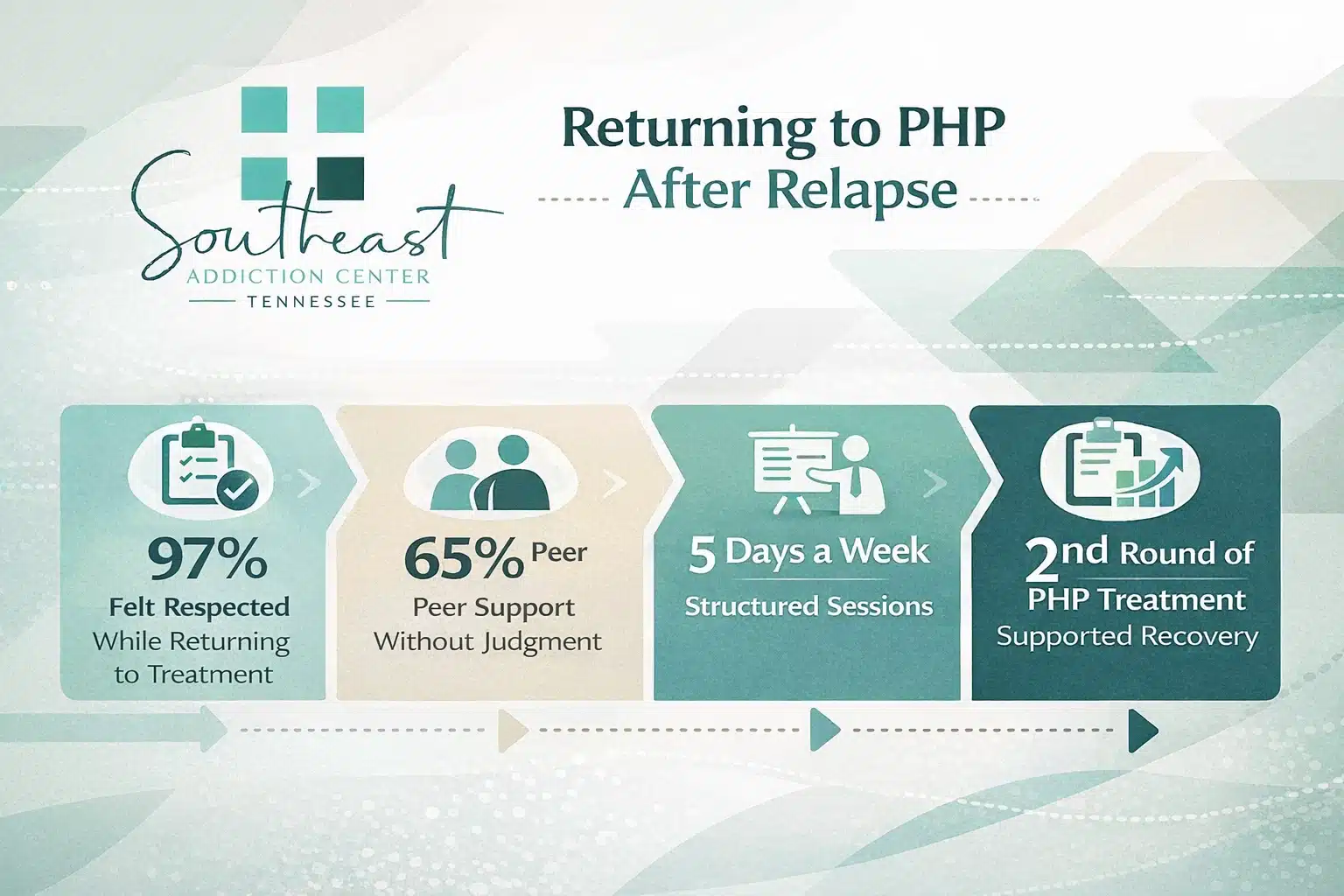
What I Learned About Myself in Round Two of PHP
I wasn’t new to treatment, but I was still learning. Maybe even more than before, because now I had something to compare it to.
Here’s what shifted in my second time through PHP:
- I let myself be honest about how hard staying sober is when life looks “fine” on the outside.
- I started untangling my relationship to pressure and performance—not just substances.
- I learned to recognize the early signs of emotional detachment I missed the first time.
- I stopped trying to win at recovery—and started living it, imperfectly.
I still did the work: group therapy, one-on-one sessions, education. But I wasn’t performing anymore. I was present.
The Power of Being Seen Without Being Judged
In group, I admitted I’d lied to people in my life. That I’d minimized how close I got to using again—before I actually did. And not one person blinked. No gasps. No lectures.
One guy looked at me and said, “Yeah. I did that too.”
And I realized: the only one keeping score was me. Everyone else was just trying to make it to tomorrow, too.
There’s something healing about being in a space where the question isn’t “Why’d you mess up?” but “What do you need now?”
That’s what PHP gave me again: a space to rebuild, not restart.
Southeast Addiction TN Didn’t Treat Me Like a Relapse—They Treated Me Like a Person
Returning to the partial hospitalization program at Southeast Addiction TN felt surprisingly grounding.
They didn’t ask me to justify coming back. They didn’t put me on some separate “relapse track.” They met me where I was—exhausted, anxious, and ready to not disappear again.
Here’s what stood out the second time:
- Familiar clinicians who remembered my story—but didn’t assume anything.
- New group members who didn’t care how many days I had—only that I was there.
- Structure that made the days feel steady, even when I didn’t.
It wasn’t about getting back to 90 days. It was about getting back to me.
If You’re Standing in That Relapse Fog—I See You
If you’re reading this because something slipped, or you ghosted your sponsor, or you told yourself you didn’t need help and now everything feels heavy again—I see you.
Coming back is scary. It bruises the ego. But it also saves your life. Again.
PHP isn’t a punishment. It’s a place to land. To slow down. To stop spiraling in your own head long enough to let someone hand you a glass of water and say, “Let’s figure this out together.”
You’re not broken. You’re still breathing. And that means it’s not too late—not even close.
Call (615) 326-6449 to learn more about our Partial Hospitalization Program in Nashville, Tennessee.