


Ninety-four days.
That’s how long I stayed sober the first time. Just over three months. Long enough to start breathing differently. Long enough to feel like my brain had a little space between the noise. Long enough to imagine a version of me who might actually make it.
I wasn’t expecting to use again. I wasn’t planning it. But I did. One night, one “just this once,” one excuse that felt too good to argue with.
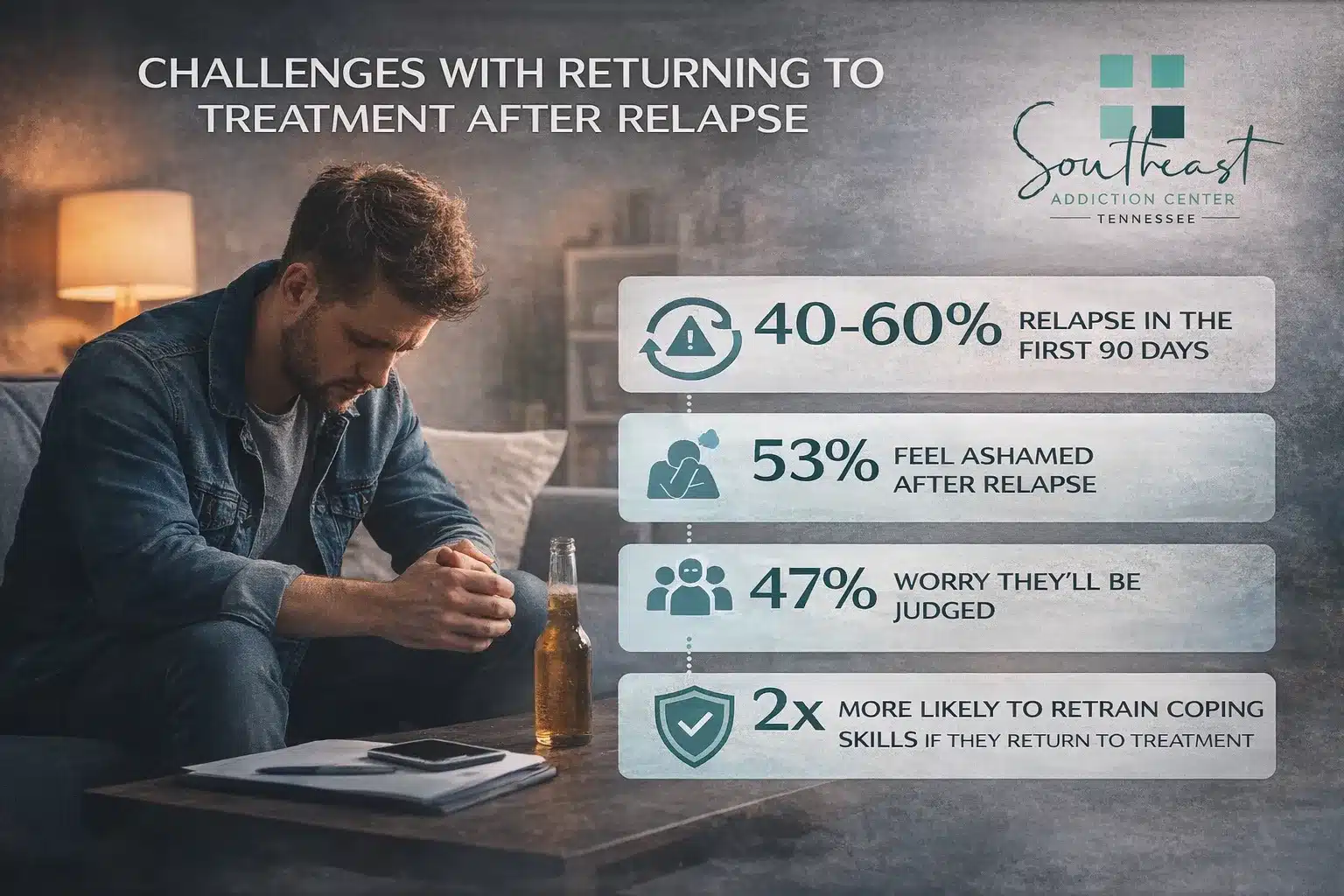
And when it was over? I sat in the aftermath, flooded with shame, sure I’d blown my shot. I didn’t know what to do next.
I thought relapse meant detox, meant crisis, meant being thrown back to the beginning. But it didn’t.
What I needed wasn’t to be stripped back down to zero. What I needed was to come back to the place that first taught me I was worth saving. And that place, for me, was Partial Hospitalization Program at Southeast Addiction.
I Thought I Had to Start Over—Turns Out, I Just Had to Start Again
Relapsing didn’t wipe my memory. I still remembered the things I’d learned. I remembered how it felt to walk through a craving without giving in. I remembered how honest I’d been with my group. I remembered how proud I was when I picked up my 60-day chip.
But I also remembered the doubt that never fully left. The part of me that kept wondering: What if I can’t keep this up forever?
I didn’t talk about that doubt the first time. I wanted to be seen as doing well. I didn’t want to let anyone down.
When I used again, all those quiet fears flooded back—this time with evidence.
See? You can’t do it. You were pretending the whole time.
But that voice wasn’t telling the truth. Because the truth was: I did do it. I had 94 solid days. I showed up for all of them. I learned. I grew. I healed.
And relapse didn’t erase that. It just meant I had more work to do—and maybe this time, I could do it more honestly.
I Didn’t Need Detox—But I Needed Structure
One of the first things I realized after using was: I didn’t need medical detox. My relapse wasn’t a full descent. It was a slip. A painful one, yes—but not the kind that left my body physically dependent again.
So when I called Southeast Addiction, I asked if there was another option. Something between outpatient and inpatient. Something that didn’t require disappearing from my life again, but that still gave me real support.
That’s when I was offered the chance to return to the same structured daytime care I’d been in before.
At first, I was scared they’d say no. That they’d judge me. That they’d write me off.
Instead, they welcomed me back like someone who never left.
I Came Back Feeling Small—But They Saw Me as Strong
Walking back into that building, I felt like every eye was going to know.
Know that I’d messed up.
Know that I didn’t “make it.”
Know that I couldn’t stay clean.
But the truth? Nobody looked at me like I was broken. Nobody rolled their eyes. Nobody asked, “What happened?”
What I got instead was a quiet nod from a therapist who just said, “You’re here. That’s what matters.”
And I needed that. I didn’t need a lecture. I didn’t need punishment. I needed to be reminded that relapse didn’t mean failure. It just meant the work wasn’t done yet.
I Wasn’t Back at Square One—Because I Wasn’t the Same Person
The second time around, everything hit different.
In group, I didn’t feel like I had to “prove” I was getting better. I’d already worn that mask. Now, I just wanted to be real. About the fear, the craving, the loneliness that crept in late at night when the phone was quiet and the walls closed in.
I realized something I never really saw the first time:
The real work starts when you stop trying to look like you’re doing it perfectly.
This time, I got honest about the things I avoided before:
- The friendships I held onto because they still used.
- The feelings I numbed instead of naming.
- The pride I mistook for progress.
Coming back wasn’t a restart. It was a deepening.
I Learned That Progress Isn’t a Straight Line
No one told me this before, but I’ll say it now in case no one’s told you:
Progress isn’t always forward. Sometimes it spirals.
You circle back to lessons you thought you mastered. You hit triggers you thought you’d disarmed. You walk back into a room you left months ago, feeling like a ghost of your former self.
And then you speak. You share. You breathe. You listen.
And you realize—this spiral is still moving up. You’re just in a loop. And that loop? It’s still growth.
I Found Other People Who’d Come Back, Too
I wasn’t the only one.
There were others in the room who’d walked the same path—gotten clean, relapsed, returned. Each one carried a mix of shame and strength. But being together meant none of us had to carry it alone.
There was the guy who slipped at his brother’s wedding.
The woman who relapsed after her dog died.
The quiet man who used after 18 months, afraid to tell his sponsor.
We didn’t trade war stories. We traded truth.
And that truth sounded like:
- “I didn’t think I’d be welcomed back.”
- “I was scared I ruined everything.”
- “I needed to know if I was still worth saving.”
And we were.
I Wasn’t a Failure—Just a Human Who Still Needed Help
If you’ve relapsed, let me tell you something I wish I’d heard sooner:
You are not your slip.
You are not your shame.
You are not “back to zero.”
You are someone who already knows the way—and just needs help walking it again, this time with less pretending and more presence.
And if structured daytime care is where you started to heal before? It can be where you keep going now.
You Don’t Have to Pretend It Didn’t Happen
If you’ve relapsed, you might be thinking:
- “They’ll never let me back.”
- “I’ve let everyone down.”
- “What’s the point of trying again?”
But let me tell you something I learned the hard way: Trying again is the point.
This isn’t about proving you’re strong. It’s about being real enough to say, “I still need help.”
And if you’ve ever felt supported in structured care before, don’t be afraid to return. It doesn’t mean you failed. It means you remembered what works.
Call 615-326-6449 or explore our structured daytime care program. We’ll meet you right where you are—no shame, no lectures, just a path back to healing.