

When your child is 20 and using again, it can feel like you’re watching a house you built catch fire from the inside out—and you’re standing outside with nothing but your hands to stop it.
Maybe they finished treatment six months ago. Maybe they swore it wouldn’t happen again. Maybe they looked you in the eye and said, “I’ve got this.” And for a while, it felt true.
Now, you’re Googling partial hospitalization programs and holding your breath. Not just hoping they’ll get help, but that this time, it might actually hold.
If you’re trying to understand what a partial hospitalization program (PHP) really is, and whether it could help your young adult child stabilize, recover, or reconnect to life—they’ve drifted from, this blog is for you.
Let’s pull back the curtain and talk honestly, clearly, and without sugarcoating.
PHP Isn’t Just “Day Rehab”—It’s Strategic, Contained Care
Despite its medical-sounding name, a partial hospitalization program isn’t a hospital. It’s not a punishment. And it’s not just a “less intense” version of inpatient rehab.
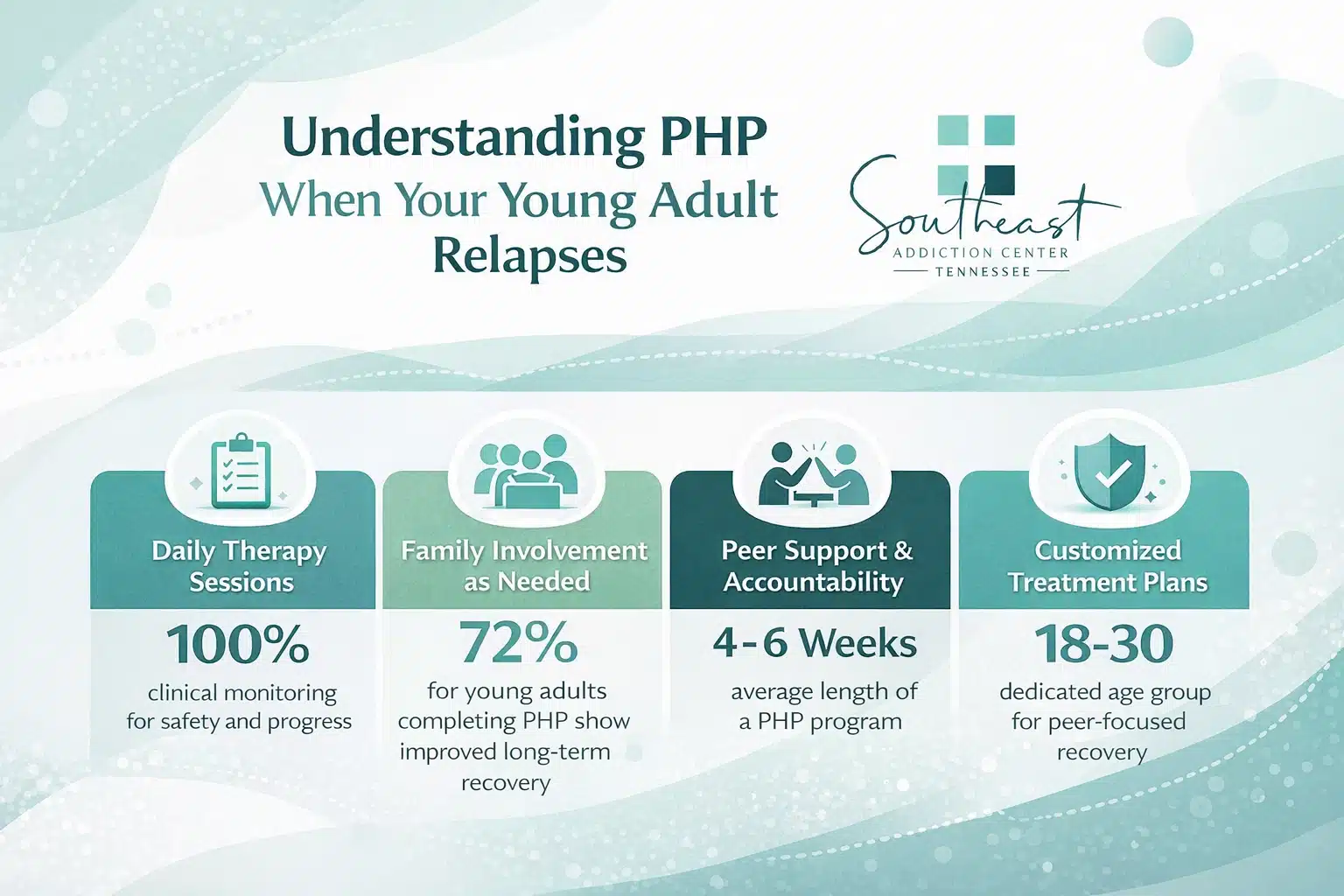
At its best, PHP is a high-accountability, high-support treatment format. Clients attend programming five days a week—often Monday through Friday—for several hours per day (usually around 6 hours). Then they return home, or to a sober living house, each evening.
That structure means your child gets:
- Daily therapy — individual, group, and sometimes family
- Clinical oversight — psychiatric evaluations, medication support if needed
- Education — about addiction, emotional regulation, relapse prevention
- Peer accountability — from others who are also in early-stage healing
It’s not babysitting. It’s not a soft option. It’s real, intensive work—without requiring your child to leave their life entirely behind.
When Inpatient Feels Too Big and Outpatient Feels Too Small
You might be wondering, Why not just send them back to inpatient?
Maybe they’ve been there already. Maybe insurance won’t cover it. Maybe they won’t agree to it again—and you know pushing too hard will push them out the door.
Partial hospitalization is the bridge between full-time residential care and weekly outpatient therapy. It offers the same level of clinical depth as inpatient, but with more freedom, autonomy, and flexibility.
This can make all the difference for young adults, especially those who:
- Are legally adults but emotionally overwhelmed
- Have “slipped” but aren’t in acute crisis
- Need help reconnecting to motivation and accountability
- Are more likely to agree to help if it doesn’t mean total disconnection
PHP offers treatment without erasing their independence. That can be the invitation they need to say yes.
Your Child Will Not Be Alone in This
One of the most healing parts of PHP is the peer dynamic.
At Southeast Addiction TN, our young adult PHP groups are made up of people in the same age range (often 18–30). Your child won’t be the youngest in a room full of older adults—or the only one trying to navigate early adulthood while dealing with mental health, substance use, or both.
The group experience often includes:
- Daily check-ins that build trust and consistency
- Guided peer feedback (led by a therapist, not a free-for-all)
- Social and emotional learning that feels relevant—not clinical lectures
- Honesty, vulnerability, and (sometimes) humor about the messy in-between space of early adulthood
Young adults often open up more when they don’t feel pathologized—but when they’re met by others who say, “Yeah, me too.”
It’s Not Just About Talking—It’s About Rewiring
Therapy isn’t just a place to vent. In PHP, your child is actively learning how to:
- Interrupt self-destructive thought spirals
- Identify emotions before they hijack behavior
- Build distress tolerance and emotional regulation
- Create real-world relapse prevention strategies
- Understand the mental health diagnoses that might be impacting their choices
Our clinical team uses evidence-based modalities like:
- Cognitive Behavioral Therapy (CBT)
- Dialectical Behavior Therapy (DBT)
- Motivational Interviewing (MI)
- Trauma-informed approaches where needed
These aren’t just buzzwords. They’re real tools that help shift stuck patterns and retrain the brain over time.
Family Involvement—When It Helps, Not Hurts
You’ve probably been told “don’t enable.” You’ve probably been blamed. Maybe you’ve even started blaming yourself. But the truth is: your presence still matters.
In our PHP, we invite family involvement when it’s clinically appropriate. That might mean:
- Regular updates with a therapist
- Family therapy sessions to rebuild communication
- Education around boundaries, codependency, and sustainable support
We never force family contact that’s unsafe or counterproductive. But when a parent’s support can stabilize, not control, we help build those bridges.
The Goal Isn’t Perfection. It’s Progress.
A lot of parents want to know: What’s the success rate?
We get it. You’ve invested time, money, energy, and your entire heart into helping your child. You want assurance.
Here’s the honest answer: success in PHP isn’t always a clean “before and after.” For many young adults, success looks like:
- Returning after a relapse instead of disappearing for months
- Learning how to ask for help before crisis hits
- Being able to sit through uncomfortable emotions without using
- Rebuilding trust slowly—not perfectly—with you
It’s not instant change. But it’s forward motion. And it’s often the shift that makes longer-term recovery possible.
What Southeast Addiction TN Offers in Young Adult PHP
Our partial hospitalization program at Southeast Addiction TN is built with young adults—and their parents—in mind.
We offer:
- Dedicated young adult PHP groups (18–30)
- Licensed clinicians who specialize in developmental stages
- Optional housing if home isn’t the safest environment right now
- Family engagement options to support, not shame
- Transition planning—whether to IOP, outpatient, or sober living
We don’t expect your child to arrive “ready.” We just ask that they show up. From there, we help them build readiness, resilience, and routine.
FAQs for Parents About PHP
Will my child be safe in PHP?
Yes. Our PHP is clinically supervised, includes risk assessment, and connects to higher levels of care if safety becomes a concern. We monitor for emotional, behavioral, and psychiatric safety daily.
What if they don’t want to go?
Many young adults agree to PHP because it feels less restrictive than inpatient—and less casual than outpatient therapy. It’s often a “yes” when “rehab” is a hard no. We can help you frame the invitation in a way that feels respectful, not punitive.
Is there drug testing?
Yes. We conduct regular drug screens and address results clinically—not punitively. Relapse is not a moral failure. It’s a signal for support.
How long does PHP usually last?
The average stay is around 4–6 weeks, though some stay shorter or longer depending on clinical needs. We reassess weekly and adjust as progress is made.
Can I be part of their care without taking over?
Yes. Our family support model is built to empower you without pulling you back into crisis-management mode. We help you set boundaries that protect you too.
Does insurance cover PHP?
Most major insurance plans offer coverage for PHP. Our admissions team can verify your benefits and walk you through every step.
A Final Word for the Parent Who’s Tired, Scared, and Still Standing
You’ve probably lost sleep, questioned your instincts, cried in secret, and smiled through gritted teeth. You’ve said no when you wanted to say yes. Said yes when you weren’t sure it would matter. And now—you’re here. Still showing up. Still looking for help.
We see you.
You’re not naïve for hoping. You’re not foolish for trying again. You’re a parent. And your love is still a strength—not a failure.
Call (615) 326-6449 to learn more about our Partial Hospitalization Program in Nashville, Tennessee.