


You don’t look like someone who needs treatment.
You show up early. You stay late. You handle your responsibilities. You’re the steady one. The productive one. The one other people rely on.
And yet, somewhere behind all that competence, something has been quietly unraveling.
If you’re here, reading this, there’s a good chance you’re not falling apart publicly.
You’re just tired of holding it together privately.
Within the first real moment of honesty, many high-functioning professionals begin looking at options like our multi-day weekly treatment option. Not because they’ve lost everything.
But because they’re starting to lose themselves.
I Wasn’t a “Mess.” I Was Managing.
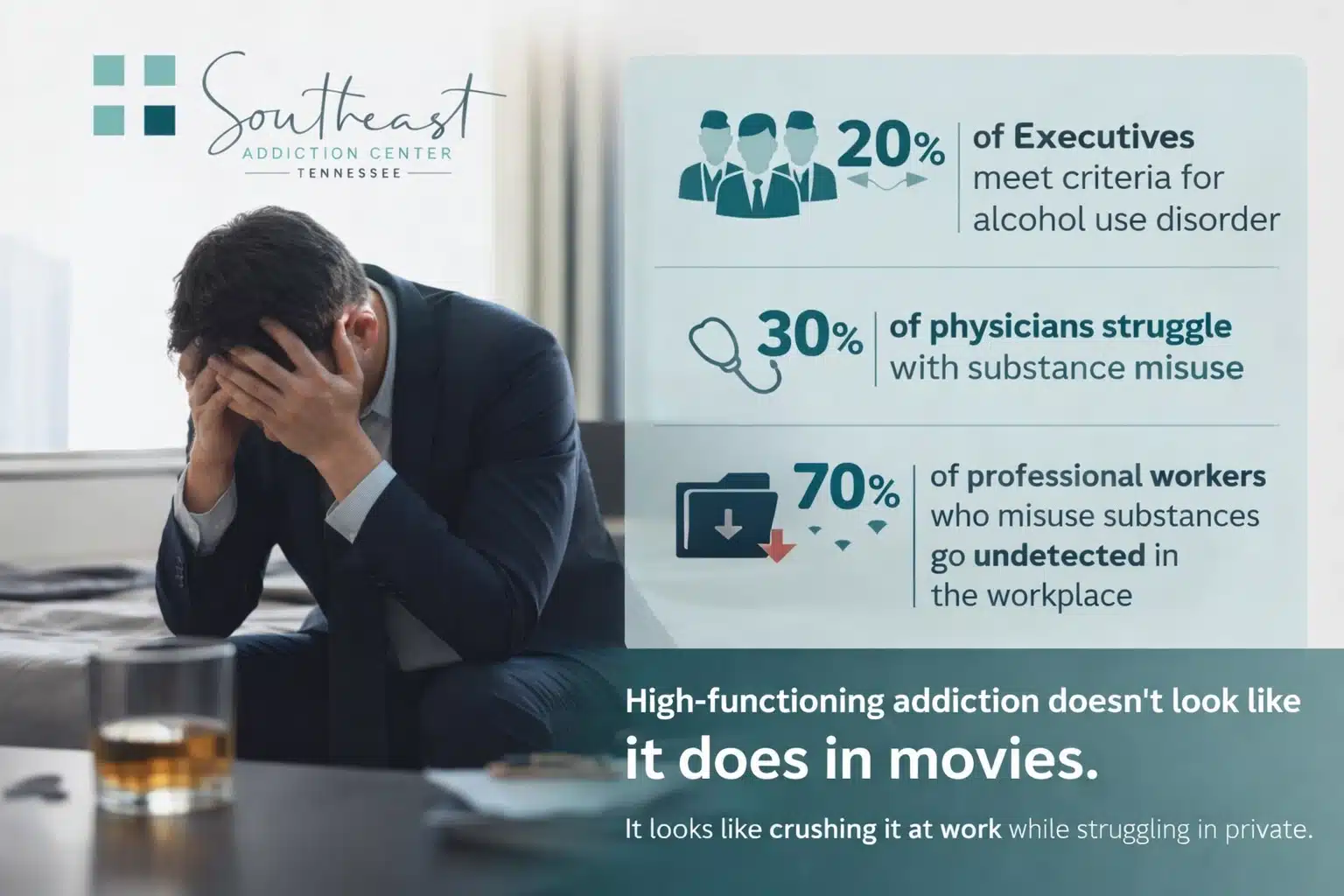
High-functioning addiction doesn’t look like what you see in movies.
It looks like:
- Crushing a presentation while nursing a hangover.
- Telling yourself “just weekends” and quietly expanding the definition.
- Keeping a stocked bar that feels less like luxury and more like insurance.
- Scheduling your day around when you can finally exhale with a drink or a pill.
From the outside, nothing is burning down.
From the inside, you are calculating constantly.
How much.
When.
Where.
Who knows.
The real cost isn’t chaos. It’s mental bandwidth.
You are running two full-time jobs: your career, and managing your use.
Eventually, the math stops working.
The Night It Got Quiet Enough to Hear Myself
For most high-functioning adults, there isn’t a dramatic rock bottom.
There’s a quiet moment.
Maybe you’re alone after everyone’s asleep.
Maybe you’re staring at a half-empty glass.
Maybe you’re scrolling, numb, knowing you said you wouldn’t do this tonight.
And a thought slips in:
“I don’t actually like this anymore.”
That’s not weakness.
That’s clarity trying to break through the noise.
The problem is, clarity is inconvenient when your identity is built on competence.
The Lie That Kept Me Stuck: “If It Was Serious, I’d Be Failing”
Here’s the myth that keeps high achievers trapped:
“If this were really a problem, I wouldn’t still be succeeding.”
But functioning is not the same as thriving.
You can:
- Hit revenue goals.
- Parent your kids.
- Lead teams.
- Maintain friendships.
And still feel dependent.
Still feel anxious when supply runs low.
Still feel your mood dip sharply when you try to stop.
Addiction doesn’t require collapse to qualify as harmful.
It just requires progression.
And high-functioning addiction progresses quietly.
It tightens its grip while your resume keeps expanding.
I Didn’t Want Rehab. I Wanted My Life Back.
Let’s be honest about what stops most professionals from reaching out.
You don’t want to disappear from work.
You don’t want to explain a 30-day absence.
You don’t want your name attached to something that feels extreme.
You want help — but you want it on terms that don’t blow up your life.
That’s why many people in your position eventually choose structured, multi-day weekly care rather than round-the-clock support. It allows you to keep your responsibilities while addressing the part of your life that’s quietly running you.
You don’t have to abandon your career to protect your future.
You just have to stop pretending the pattern is sustainable.
The Double Life Became Heavier Than the Habit
The real rock bottom for high-functioning people isn’t a DUI.
It’s the split.
The gap between the person everyone sees and the one negotiating cravings at night.
It’s smiling through client dinners while tracking how much you’ve consumed.
It’s hiding bottles.
It’s deleting call logs.
It’s calculating how much is “too much” and adjusting the narrative accordingly.
That split creates isolation.
And isolation feeds the cycle.
At Southeast Addictions, we’ve worked with physicians, executives, attorneys, entrepreneurs — people whose lives looked impressive from the outside. The breaking point was rarely public humiliation.
It was exhaustion from maintaining the illusion.
When Control Starts Slipping — Just Slightly
High-functioning addiction rarely collapses all at once.
It erodes.
First, sleep changes.
Then irritability creeps in.
Then you notice anxiety when you try to skip a night.
Then your “rules” start bending.
“I don’t drink during the week” becomes “just Thursdays.”
“Only socially” becomes “it counts if I’m texting someone.”
“Just two” becomes “I’ll start fresh Monday.”
The scariest part isn’t the behavior.
It’s watching your own standards slowly shift.
When self-trust erodes, everything feels less solid.
That’s often when someone finally considers stepping into an Intensive outpatient program — not because they’ve detonated their life, but because they can see the trajectory.
And they don’t like where it’s heading.
The Fear: “What If I’m Overreacting?”
This question shows up almost every time.
“What if I’m making this bigger than it is?”
Let’s flip that.
What if you’re minimizing something that’s steadily expanding?
You don’t search for treatment options casually.
You don’t read blogs like this if it’s just a passing thought.
High-functioning people are excellent at rationalization. You can argue both sides convincingly.
But here’s the simplest metric:
If stopping feels harder than it should — it matters.
If cutting back consistently fails — it matters.
If your mood, energy, or relationships are subtly deteriorating — it matters.
You don’t need catastrophe to justify support.
You need honesty.
What Finally Pushes Someone to Say Yes
It’s rarely drama.
It’s accumulation.
- The creeping anxiety you can’t explain.
- The Sunday night dread.
- The subtle disconnect from people you love.
- The growing realization that you’re living at 70% capacity.
Eventually, the cost of staying the same outweighs the fear of change.
That’s the tipping point.
And when that moment comes, the most empowering move isn’t waiting for collapse.
It’s choosing intervention while you still have leverage.
While you still have your job.
While you still have your relationships intact.
While you still recognize yourself.
That’s not weakness.
That’s strategy.
What Structured Weekly Support Actually Changes
We won’t give you a lecture here.
We’ll tell you what clients often report after beginning structured weekly care:
- They sleep better within weeks.
- Anxiety decreases when secrecy disappears.
- Cravings become manageable when processed in real time.
- Work performance often improves because mental bandwidth returns.
- Self-respect slowly rebuilds.
The shift isn’t magic.
It’s consistency.
It’s having accountability several days a week instead of white-knuckling alone.
It’s learning tools in the morning and applying them that same afternoon.
It’s replacing isolation with community.
You don’t have to hit rock bottom to benefit from that.
You just have to be tired enough of the split.
The Real Question Isn’t “Am I That Bad?”
It’s:
“How long do I want to keep living like this?”
You’ve proven you can function under pressure.
You’ve proven you can endure discomfort.
The question is whether endurance is the life you want.
High-functioning addiction survives on comparison.
“At least I’m not…”
“It’s not as bad as…”
But your standard doesn’t have to be “worse than someone else.”
It can be:
“I want better than this.”
That’s enough.
If you’re ready to explore what structured, multi-day weekly care could look like without dismantling your life, our team is here to have that conversation — directly and confidentially.
Call (615) 326-6449 to learn more about our Intensive outpatient program in Nashville, Tennessee.