


Sometimes it doesn’t happen all at once.
You miss one session. Then another. Then the idea of responding to messages from your counselor starts to feel uncomfortable. Days turn into weeks, and eventually the silence becomes long enough that coming back feels… strange.
If you stepped away from treatment and now aren’t sure how to return, you’re not alone. Many people pause mid-treatment when motivation fades or life gets complicated. Reconnecting with something like multi-day weekly treatment can still be possible — even if you’ve been gone longer than you planned.
The most important thing to know right now is simple: the door is rarely as closed as it feels.
Start by Dropping the “I Messed Everything Up” Story
The biggest barrier to returning usually isn’t scheduling or logistics.
It’s shame.
Many people who stop showing up believe they’ve ruined their chance. They imagine that the treatment team is disappointed or frustrated. Some assume they’ll have to explain themselves in a way that feels humiliating.
But here’s the truth most people don’t realize: dropping out of care happens often.
People leave because work schedules shift. Family stress intensifies. Mental health symptoms spike. Sometimes motivation simply disappears.
None of those things make you a failure.
Recovery isn’t a straight road. It’s more like learning to walk across uneven ground. You’ll pause. You’ll stumble. Sometimes you’ll step away from the path for a while.
What matters most is not the pause.
It’s the willingness to return.
Take One Honest Look at What Happened
Before jumping back into treatment, it can help to slow down and ask yourself a simple question:
Why did I stop going?
This question isn’t about blaming yourself. It’s about understanding what changed.
Some people step away because the emotional work started hitting deeper layers than expected. Therapy can bring up memories, pain, and vulnerability that feel overwhelming.
Others leave because life responsibilities pile up. Work, childcare, school, and relationships can quickly make treatment feel like one more thing to juggle.
And sometimes people leave because things started feeling better.
When life stabilizes even slightly, the brain can start whispering:
Maybe I don’t need this anymore.
Understanding the real reason you stepped away can help you return with more clarity this time.
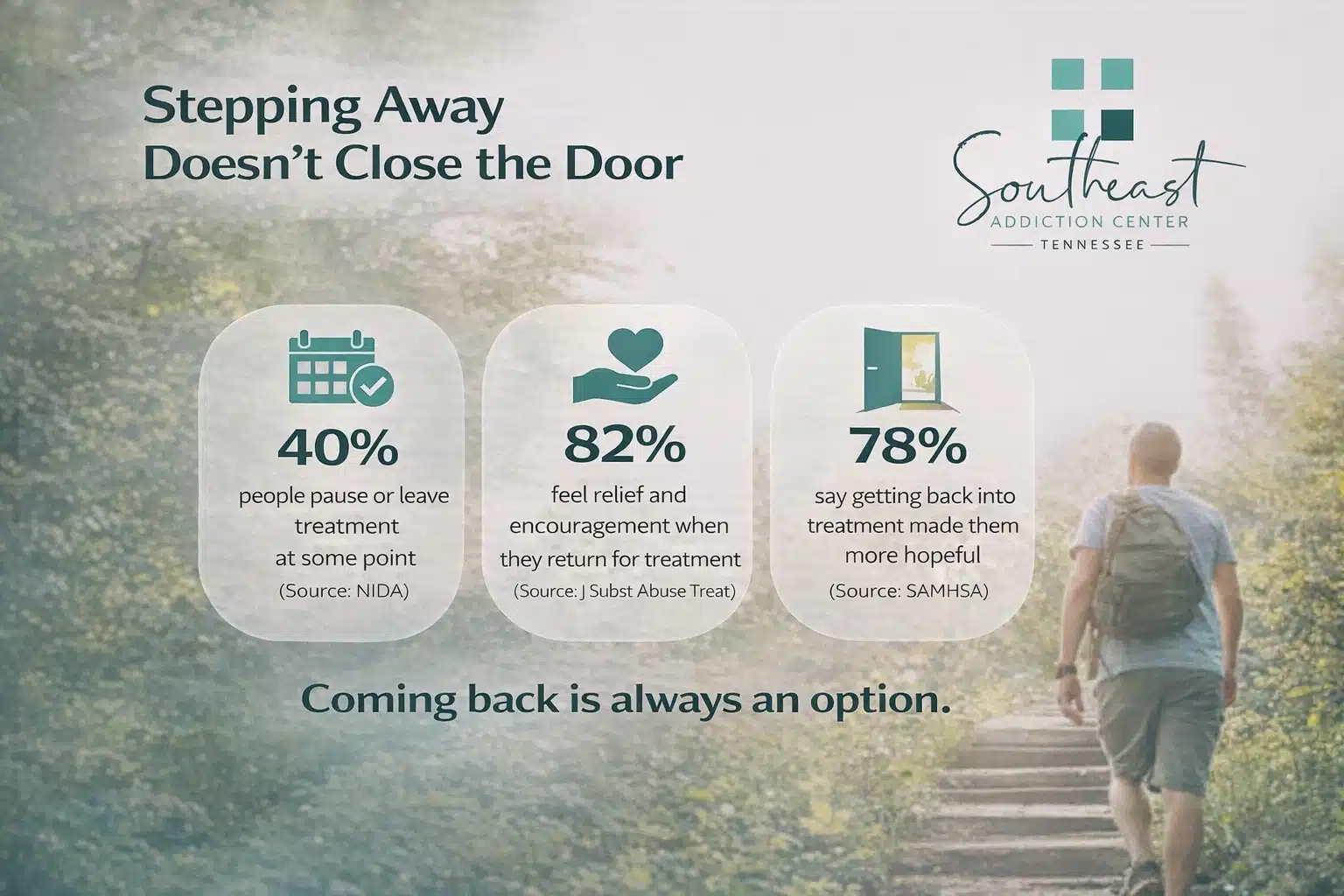
Lower the Bar for Getting Back In
One of the most common traps people fall into is believing they need to feel motivated before returning.
But motivation rarely appears out of nowhere.
In fact, many people rediscover motivation after reconnecting with support.
Think of motivation like a fire that needs oxygen. Isolation tends to smother it.
Instead of waiting until you feel fully ready, focus on the smallest step available.
That might be:
- Sending a text message to your counselor
- Calling the treatment center to ask about restarting
- Scheduling a brief conversation about what returning might look like
Small actions have a surprising effect. They create movement. And movement often brings motivation back with it.
Let the Awkwardness Exist
Returning after disappearing can feel uncomfortable.
You may imagine walking into a session and everyone noticing you haven’t been there. You may worry about questions like:
“Where have you been?”
But in most cases, treatment providers are less focused on the absence than you think.
They’ve seen people step away and return before.
Recovery isn’t a straight line for most people. It includes pauses, setbacks, and moments of doubt.
When someone reconnects after disappearing, the usual response isn’t judgment.
It’s relief.
Because reaching out again often means someone decided they still want things to change.
And that decision matters.
Rebuild Structure Before Motivation
Motivation can feel unpredictable during recovery.
Some days it’s strong. Other days it disappears completely.
That’s why many treatment approaches focus less on motivation and more on structure.
Structure creates rhythm in your week. It gives your brain predictable patterns that reduce stress and decision fatigue.
Returning to regular treatment sessions, even when motivation is low, can gradually rebuild that rhythm.
Think of structure like the frame of a house. Motivation is the energy that fills the rooms, but structure keeps the building standing when energy dips.
Without structure, motivation tends to fade faster.
Focus on Showing Up, Not Doing It Perfectly
A lot of people stop attending treatment because they feel like they’re failing at recovery.
Maybe you relapsed. Maybe you didn’t complete assignments or follow through on coping strategies. Maybe you just felt stuck.
The pressure to “do recovery right” can become overwhelming.
But recovery isn’t a performance.
It’s a process.
Showing up tired, frustrated, confused, or unmotivated is still showing up. And sometimes those sessions — the ones where you feel the least put together — are the most meaningful ones.
Healing doesn’t require perfection.
It requires honesty.
Remember Why You Started in the First Place
When motivation disappears, it’s easy to forget why you started treatment at all.
The brain tends to minimize past pain once it begins to fade. Problems that once felt urgent start to feel distant.
But there was a reason you reached out for help originally.
Maybe things felt chaotic. Maybe relationships were breaking down. Maybe you were exhausted from carrying everything alone.
Those reasons didn’t vanish.
They may simply be buried under discouragement or fatigue.
Reconnecting with treatment can bring those motivations back into focus — not through pressure, but through conversation and support.
Recovery Isn’t Measured by Perfect Attendance
Many people assume recovery means never missing a step.
But real recovery stories rarely look that tidy.
People pause. People doubt themselves. People take breaks and then come back stronger.
The important thing isn’t whether you disappeared for a while.
The important thing is that you’re thinking about reconnecting now.
That thought alone suggests something inside you still believes change is possible.
And that belief deserves attention.
The Door Is Still Open
If you stopped showing up and now feel unsure how to return, remember this:
You don’t have to explain everything perfectly.
You don’t need to arrive fully motivated.
You don’t need to prove anything.
You just need to take one small step back toward support.
Call 615-326-6449 to learn more about our Intensive outpatient program in Nashville, Tennessee.