


You don’t have to be in crisis to question your relationship with substances. You don’t need to have a “rock bottom” moment to wonder if therapy, support, or even a structured treatment program might help you feel more in control.
Maybe you’ve been thinking:
- “I’m not falling apart, but I’m not thriving either.”
- “I’m managing—but it takes everything I’ve got.”
- “I just want to understand why I keep going back to this.”
If that’s you, this blog is for you.
At Southeast Addiction, we talk to people every day who are somewhere in between. Not fully sure they need help—but not fully okay either. You don’t have to have all the answers to start asking questions.
Here’s how to know if structured daytime care—like the kind we offer in Tennessee—might be the right fit.
You Don’t Have to Hit a Low Point to Want Change
Let’s clear this up first: treatment isn’t just for the worst-case scenario.
It’s for the person whose drinking or use has started creeping into their thoughts more than they’d like. It’s for the person who still goes to work and shows up for their family, but feels emotionally fried every night. It’s for the person who can hold it all together on the outside—but feels lost inside.
You can want more peace, more balance, more understanding—without needing to justify your pain by how dramatic it looks.
In fact, one of the most powerful times to explore treatment is when you’re still functioning… but questioning. Still holding it together… but tired of the pressure.
You’ve Tried Managing It Yourself—But It’s Not Enough
You’ve read the books. You’ve cut back. You’ve tried the morning routines, the “just on weekends” rule, the exercise plans, the journaling apps.
Maybe it helped—for a while.
But if you keep ending up in the same place—feeling anxious, foggy, disconnected—it’s not because you’re weak. It’s because some patterns are deeper than willpower alone can touch.
Structured treatment can offer something different: a safe container, a daily rhythm, and a space to go deeper into the “why” behind your patterns. Not just behavior change, but inner change. That’s not something you have to tackle solo.
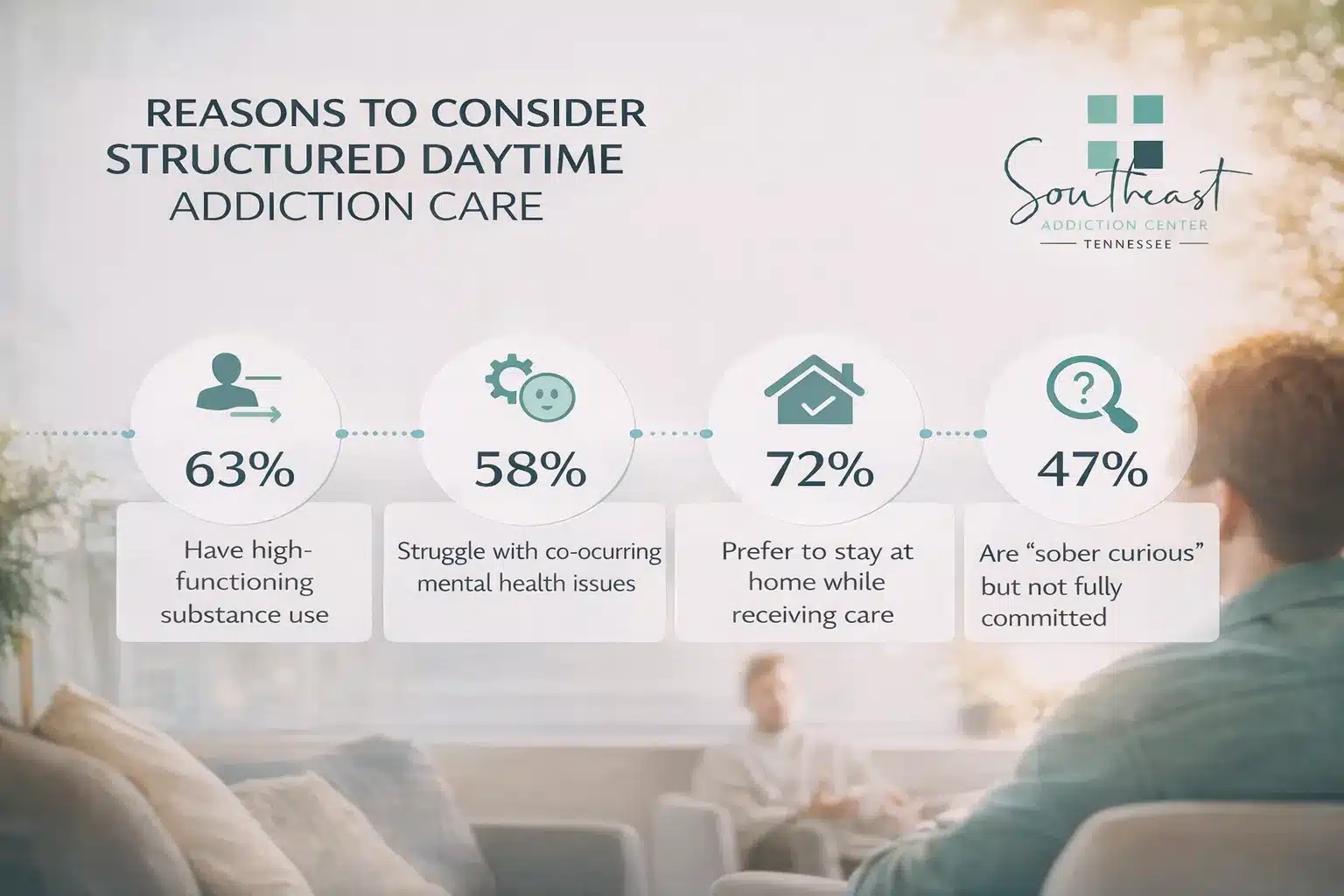
Your Mental Health Feels Messy and You’re Not Sure Why
It might not even be about substances. It might be that your mood is unpredictable, your energy is shot, and things that used to bring you joy now feel like chores.
You’re wondering if it’s anxiety, depression, burnout—or something else entirely. And when you do try to feel better (or numb out), substances are sometimes part of the picture.
You’re not broken. You’re human. And you deserve support that sees the whole picture, not just the part that looks the most “clinical.”
When mental health and substance use collide, programs like structured daytime care can give you a safe, grounded space to untangle it all—with professionals who actually listen.
You Want to Stay Connected to Real Life While You Heal
A lot of people think “getting help” means checking into a facility, quitting your job, or pressing pause on your whole world.
That’s not always true.
Structured daytime care is designed for people who want:
- Daily or near-daily support, without overnight stays
- A space to explore deeper healing, while sleeping in their own bed
- Real-time tools for managing life’s demands—without disappearing from life itself
Think of it like a middle path between weekly therapy and full-time residential treatment. It’s a way to get meaningful support without stepping fully away from your day-to-day life.
You’re More Curious Than Committed—And That’s Okay
Let’s be real: you might not be ready to label your behavior as “addiction.” You might not even want to quit entirely. You’re just noticing patterns that don’t feel good.
That counts.
Being sober curious is about noticing your relationship with substances, emotions, or mental health—and asking honest questions about whether it’s serving you.
You don’t have to be “ready to change everything” to benefit from a structured program. Sometimes, just being willing to ask those questions in a safe space is the change.
We’ll never pressure you. We’ll meet you where you are.
You Want Real Tools—Not Just Pep Talks
You’ve probably heard it all:
- “Just love yourself more.”
- “Practice gratitude.”
- “Try not to think about it.”
Nice ideas. Not enough.
Structured care offers actual tools:
- Cognitive strategies to manage anxious thinking
- Group processing to feel less alone
- Coping techniques that aren’t just “self-care” memes
It’s not about fixing you—it’s about equipping you. So you can handle real life without losing yourself in it.
You Want to Understand, Not Just Stop
Maybe your goal isn’t even sobriety. Maybe it’s clarity.
You want to know:
- Why do I keep going back to this?
- What am I avoiding?
- Who would I be without this crutch?
That’s not a weakness—it’s deep emotional intelligence. And it’s the kind of work that structured programs make space for.
No judgment. No pressure. Just support for the questions you’re already asking yourself.
You Just Want to Talk to Someone Without Being Sold Something
Not ready to commit? Good.
This isn’t about convincing you. It’s about offering a real conversation. One where you can say:
- “I’m just exploring.”
- “I’m not sure this is for me.”
- “Can I ask a few questions?”
And get real answers, from real humans, without a pitch.
That’s what happens when you call us.
At Southeast Addiction, we talk to curious, cautious people all the time. And we respect wherever you’re at.
You Don’t Have to Be “All In” to Take a First Step
Curiosity is enough. Doubt is allowed. Fear is expected.
If you’ve made it this far, something in you is already reaching for change.
And you don’t have to figure it all out today. You just have to ask one honest question: Could support like this help me feel better?
Let’s explore that together.
Call 615-326-6449 or explore our partial hospitalization program in in Nashville, Tennessee. No pressure. Just a conversation. One human to another.