


You didn’t wake up one morning and decide, “I’m done.”
It was smaller than that.
You missed one session.
Then you told yourself you’d explain next time.
Then next time felt awkward.
Then your phone buzzed and you didn’t answer.
And now here you are — somewhere between wanting help and not knowing how to walk back through the door.
If you’ve been thinking about returning to structured support like our multi-day weekly treatment option, I want to talk to you the way I would if you were sitting in my office right now.
Not disappointed.
Not frustrated.
Just honest.
You’re not the only person who’s done this. And you’re not too late.
Step 1: Tell the Truth About Why You Left (Without Attacking Yourself)
Most people who ghost mid-treatment don’t leave because they “don’t care.”
They leave because something spiked.
Maybe it was:
- A relapse that felt embarrassing.
- A group topic that hit too close to home.
- A schedule conflict that snowballed.
- Financial stress.
- Family pressure.
- Emotional overload.
- That creeping voice that said, “I don’t need this.”
Here’s the part that matters: leaving usually makes sense in the moment.
Avoidance often feels like relief.
Until it doesn’t.
Instead of labeling yourself as flaky or incapable, try this:
“What felt unbearable at that time?”
That question opens a door.
Shame slams it shut.
Step 2: Stop Writing the Story That You’re Not Welcome Back
This is the most common internal script we see:
“They’re probably annoyed.”
“They gave up on me.”
“I embarrassed myself.”
“I wasted their time.”
Let me be very clear.
Treatment teams expect pauses.
We expect relapses.
We expect avoidance.
Addiction and mental health struggles don’t move in straight lines. They zigzag. They stall. They regress.
Your absence didn’t offend anyone. It signaled something got hard.
And hard is exactly what treatment is designed to hold.
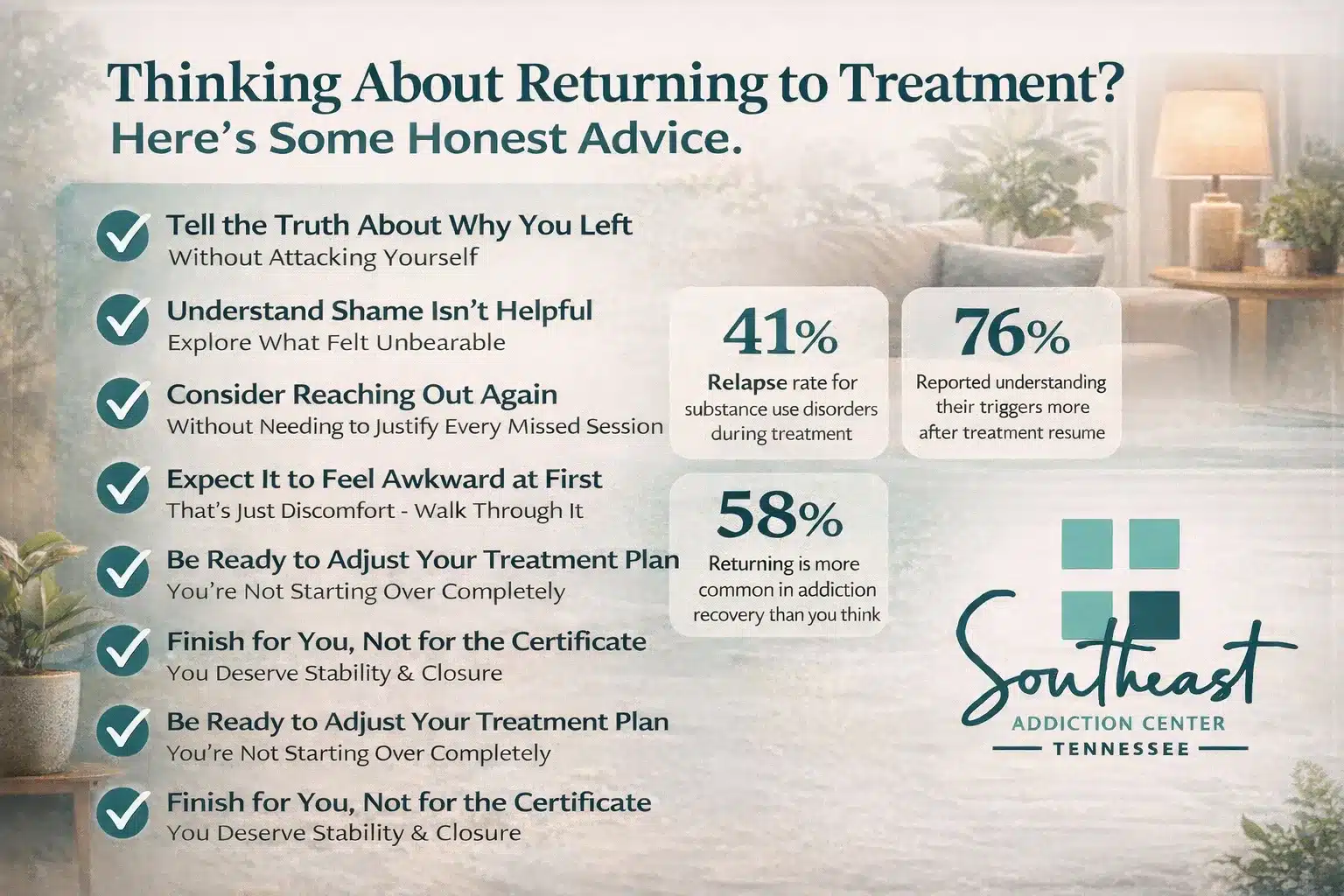
Step 3: Don’t Wait Until You’ve “Fixed It” to Return
This is where people get stuck for months.
They think:
“I’ll go back once I’ve stopped using again.”
“I’ll go back once I feel more stable.”
“I’ll go back once I’m not so embarrassed.”
But treatment isn’t a reward for already doing well.
It’s a support system for when you’re not.
If you relapsed while you were gone, that’s not a reason to stay away. It’s information.
If you’ve been spiraling a little, that’s not proof you failed. It’s proof you need structure again.
You don’t need to present a cleaned-up version of yourself to return.
You return messy.
That’s the point.
Step 4: Send the Simple, Honest Message
You don’t need a long explanation.
You don’t need to recount every day you missed.
You can say:
“Hey. I stopped coming and I think I need to come back. Can we talk?”
That’s enough.
Clinicians don’t need perfection. We need communication.
If you’re considering re-entering an Intensive outpatient program, the first step isn’t proving anything.
It’s reconnecting.
And reconnecting can be one sentence.
Step 5: Expect the Awkward — But Don’t Let It Decide for You
Walking back into a group after ghosting might feel uncomfortable.
You might imagine:
Everyone staring.
Everyone judging.
Everyone thinking you’re unreliable.
Here’s what usually happens instead:
Someone nods.
Someone says, “I’ve done that too.”
Someone’s just relieved you’re back.
The recovery room is full of people who have stopped and started more than once.
The shame in your head is louder than the reality in the room.
Discomfort is temporary.
Isolation is heavier.
Choose temporary.
Step 6: Let the Plan Change
Coming back doesn’t mean pretending nothing happened.
It means adjusting.
You may:
- Increase accountability.
- Shift your schedule.
- Explore triggers more directly.
- Add more support around relapse prevention.
- Talk about what made you leave.
That’s not punishment.
That’s calibration.
When someone leaves mid-treatment, it tells us something about what wasn’t working or what became overwhelming. That information is valuable.
You’re not restarting from scratch.
You’re returning with more data.
Step 7: Separate Shame From Responsibility
Shame says:
“I’m hopeless.”
“I always mess things up.”
“I can’t even stick with treatment.”
Responsibility says:
“I stepped away. Something wasn’t working. I want to understand it.”
We can build from responsibility.
We can’t build from shame.
Shame keeps you outside the door, staring at it.
Responsibility turns the handle.
Step 8: Remember Why You Said Yes the First Time
Before you ghosted, there was a reason you enrolled.
Maybe you were exhausted.
Maybe someone you love was scared.
Maybe you were tired of white-knuckling.
Maybe your mental health was colliding with substance use and you knew you couldn’t out-think it anymore.
Those reasons didn’t disappear just because you stopped attending.
Often, they’ve grown.
Sometimes people leave right when the work starts touching something real — trauma, grief, identity, fear.
Leaving can mean the treatment was ineffective.
But more often, it means it was getting close to something important.
Step 9: Understand That Pausing Doesn’t Erase Progress
Here’s something you may not realize.
Even if you left mid-treatment, you likely retained pieces:
- Language for your triggers.
- Awareness of patterns.
- A few coping tools.
- Names of people who understood.
- Insight you didn’t have before.
Progress isn’t erased because attendance stopped.
It stalls.
And stalled progress can move again.
You are not back at day one.
You’re at a crossroads.
Step 10: Finish for You — Not for the Certificate
Completing structured care isn’t about optics.
It’s about depth.
When people stop halfway through, they often leave before:
- Relapse prevention solidifies.
- Emotional regulation skills are practiced consistently.
- Community bonds strengthen.
- Transition planning happens.
Finishing creates closure.
It builds confidence.
It gives you something solid to stand on.
You deserve that.
Not because you owe us.
Because you owe yourself stability.
The Real Fear Isn’t Rejection — It’s Trying Again
Let’s name it.
Sometimes the fear isn’t “What will they think?”
It’s “What if I try again and still struggle?”
That fear is real.
Recovery asks you to stay engaged even when progress isn’t linear.
But here’s the alternative:
Trying alone again.
White-knuckling again.
Promising yourself “this time will be different” without changing the structure around you.
Structure isn’t weakness.
It’s leverage.
Frequently Asked Questions
Will they judge me for disappearing?
No. Treatment teams understand avoidance. We don’t interpret ghosting as disrespect — we interpret it as overwhelm or fear. The goal is to help you re-engage, not shame you.
Do I have to start over completely?
Not necessarily. Your clinical team will assess where you are now and adjust the plan. You won’t automatically lose all progress because of a pause.
What if I relapsed while I was gone?
That’s common. Relapse doesn’t disqualify you from returning. It often clarifies what level of support is needed moving forward.
I ignored their calls. Is that bad?
It’s human. Silence doesn’t close the door. You can reopen communication at any time.
What if I leave again?
Then we reassess again. Recovery is rarely linear. The goal isn’t perfection — it’s persistence.
I’m embarrassed to face the group. Can I talk to staff first?
Yes. Many people reconnect privately before rejoining group sessions. You can ease back in with support.
What if the schedule felt overwhelming last time?
That’s worth discussing. Sometimes small adjustments make a big difference. Leaving doesn’t mean the model was wrong — it may mean the fit needed tweaking.
You’re Not the Client Who Failed
Let me speak to you directly.
You’re not the dropout everyone rolled their eyes about.
You’re not the “difficult case.”
You’re someone who hit a wall.
Walls happen in recovery.
The only real question is whether you want to stay on this side of it.
Walking back through the door isn’t dramatic.
It’s quiet courage.
And quiet courage counts.
If you’re ready to explore finishing what you started, our team at Southeast Addictions is here — not with lectures, but with steadiness.
Call (615) 326-6449 to learn more about our Intensive outpatient program in Nashville, Tennessee.