


Is This More Than Just a Rough Patch?
You’re not spiraling. You’re functioning. You show up to work, text your friends back, maybe even hit the gym. But under the surface, something’s starting to ache. Maybe it’s sleep. Maybe it’s Sundays. Maybe it’s just that little voice asking: What if life could feel lighter than this?
If you’re exploring what it means to drink less, cut back, or live with more clarity, you’re not alone. The “sober curious” movement has created space for people to ask questions—without needing a crisis to justify them.
But when you’re curious and a little stuck, it can be hard to know what kind of help fits. You don’t want to blow up your life. You just want to feel better. A Partial Hospitalization Program (PHP) might be exactly what you didn’t know existed.
Let’s talk about how PHP actually works—and why it might be the missing link between curiosity and change.
You Don’t Have to “Hit Bottom” to Deserve Support
Let’s get this out of the way: You do not have to be at rock bottom to benefit from treatment.
Too often, people wait until things fall apart—because they think only people in deep crisis deserve help. That’s outdated, and honestly, a little dangerous.
Partial hospitalization programs were designed to catch people before the bottom. Maybe you’ve tried cutting back on your own, and it didn’t stick. Maybe you’re noticing patterns that feel off: hiding how much you drink, dreading mornings, using substances to unwind in ways that don’t feel like “you.”
You don’t need a label. You just need a space that’s structured enough to help you figure things out—and flexible enough not to wreck your daily life.
What Is a Partial Hospitalization Program?
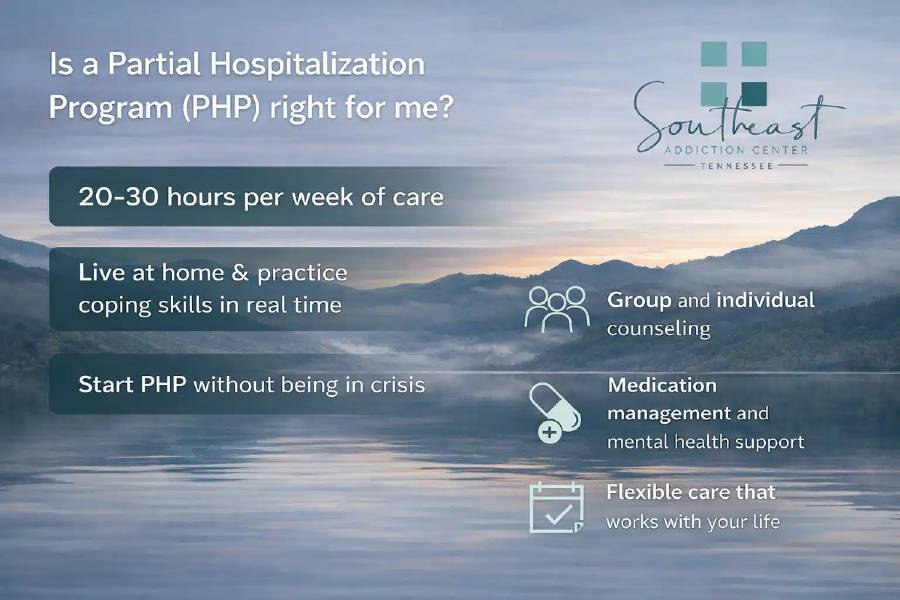
A PHP is one of the most intensive forms of outpatient care. It typically runs five to six hours per day, five days a week. But unlike inpatient or residential treatment, you still live at home—or in a sober living house—while attending.
Here’s what PHP usually includes:
- Group therapy with peers who are also exploring change
- Individual sessions with a therapist or counselor
- Medication management, if applicable
- Mental health support, especially if anxiety, depression, or trauma are part of your story
- Life skills and coping tools that translate into your real, daily routines
In short, PHP gives you a deep level of support—without requiring you to disappear from your life.
You Go Home at Night—And That Matters
One of the things people love most about PHP is this: You go home at the end of the day.
That means you can practice what you’re learning in real-time. You get to see how your coping skills show up when your roommate’s loud, your inbox is full, or the wine bottle is still in the kitchen. And if you struggle? You bring it back into the next day’s group.
It’s recovery with a feedback loop. Real life included.
It Works for the “In-Between” Phase
Maybe you’re not sure if you want to quit drinking forever. Maybe you’re worried about your weed use, but you don’t feel like it’s “bad enough” for treatment. That’s the exact space where PHP can be powerful.
You don’t have to be ready for lifelong sobriety to start making changes. PHP gives you a chance to explore what your life could feel like—without substances—while offering the tools and insight to help you decide what’s next.
Success Stories Don’t All Look the Same
At Southeast Addiction TN, we see all kinds of outcomes—and that’s a good thing.
One client came in hoping to take a 30-day break from drinking. They stayed in PHP for six weeks, found clarity they weren’t expecting, and decided to pursue long-term sobriety. Another client came in burned out and anxious, unsure if substances were even the core issue. With support, they learned to set boundaries, improve sleep, and reduce drinking without feeling deprived.
Success doesn’t always mean total abstinence. Sometimes it means more agency. More peace. More mornings you’re proud of.
“I didn’t think I belonged in a program like this. But after the first week, it just felt like… space to think clearly. I wasn’t being told what to do. I was finally being asked what I wanted.”
– Southeast Addiction PHP Client, 2023
It’s Not Forever. And It’s Not All or Nothing.
Most PHP participants stay for a few weeks to a couple of months. It’s not a life sentence—it’s a reset.
And when you’re ready, you can step down to an intensive outpatient program (IOP) or even regular outpatient therapy. Think of PHP as scaffolding. It’s there when you need structure, but the goal is to help you build something sustainable.
You Don’t Have to Know Exactly What You Want
One of the biggest myths about getting help is that you have to be sure—sure you want to quit, sure you’re “addicted,” sure this is the answer.
But most people enter PHP unsure.
You’re allowed to show up with questions. With ambivalence. With both wanting more and not wanting to let go of what’s familiar.
PHP makes space for that. It’s not about shoving you into a box—it’s about walking with you while you figure out what you want life to look like.
Quick Glance: Is PHP Right for Me?
You might be a good fit for partial hospitalization if:
- You’re exploring sobriety or moderation but struggling to make changes on your own
- You feel like substances are taking up more mental and emotional space than you want
- You’re dealing with anxiety, depression, or trauma alongside substance use
- You’re not in immediate crisis but know things aren’t sustainable
- You’re craving structure, clarity, and support—but not residential care
What Happens If I Start and It’s Not the Right Fit?
That’s okay. Starting PHP doesn’t lock you into a specific outcome. If it feels too intense, you might step down into a lower level of care. If it turns out you need more support, your team will help you explore options.
The point isn’t to trap you. It’s to give you options—without waiting for a crisis.
Real Recovery Starts With Real Life
You don’t have to pause your life to get help. You don’t need a rock bottom or a diagnosis. You just need curiosity, a little courage, and a safe space to figure things out.
Our Partial hospitalization program in Tennessee was built for people like you—thoughtful, functioning, unsure… and ready for something more.
Ready to ask questions or take the next step?
Call (615) 326-6449 to learn more about our Partial hospitalization program services in Tennessee. Let’s find out what real support can look like—on your terms.