


Sometimes the hardest part isn’t starting—it’s starting again.
If you’ve dropped out of an intensive outpatient program (IOP), ghosted group sessions, or slowly drifted away from treatment, it might feel like the door is closed. Like you’ll be met with a lecture or cold professionalism if you try to come back.
But here’s the truth: That door is still open. At Southeast Addiction’s intensive outpatient program in Nashville, TN, we understand that recovery rarely moves in a straight line. Life pulls at you. Motivation flickers. And sometimes, walking back through those doors takes more courage than the first time.
This blog is for anyone sitting in that space—uncertain, maybe ashamed, maybe just tired. If that’s you, keep reading. You’re not alone. You’re not too late. And this next step doesn’t have to be perfect. It just has to be yours.
You Are Still Welcome—No Explanation Required
The first thing we want you to know? You don’t need to justify yourself to come back.
Maybe you left because you were overwhelmed. Maybe your schedule got chaotic. Maybe something inside you said, “This isn’t working.” Whatever the reason, we’re not here to quiz you about it.
In fact, many people leave treatment and return later—sometimes weeks later, sometimes years. What matters is that you’re considering reconnecting. That’s enough to begin.
We don’t keep score. We don’t close doors.
Ghosting Happens—And It Doesn’t Make You a Failure
Let’s name it plainly: dropping out or disappearing mid-treatment can bring a wave of guilt.
You might think:
- “They probably think I don’t care.”
- “I blew my chance.”
- “I should’ve stuck it out.”
But none of that disqualifies you from care. Ghosting isn’t proof you don’t care—it’s often a sign that something was too painful, too hard, or just too much at the time. And that’s valid.
If you didn’t have the words or energy to explain yourself then, you don’t owe a dramatic return speech now. Just showing back up is enough.
The Motivation Doesn’t Have to Be There Yet
This part matters: you don’t have to be “fully ready” to come back.
Motivation isn’t a requirement. It comes and goes—especially in early or interrupted recovery. One week, you might feel strong and clear. The next, you’re flatlined. That’s not a flaw. It’s part of the process.
You don’t have to feel “on fire” about recovery to benefit from an intensive outpatient program. You just need a crack of willingness—a sense that maybe life could feel different. We can work with that.
Some days, the strongest thing you’ll do is show up tired, unsure, or even skeptical. That counts.
Re-Entry Is Easier Than You Think
If you’re imagining a dramatic return—awkward hellos, judgmental stares, tough questions—you’re not alone. That fear keeps a lot of people from re-engaging with care.
But in reality? Re-entry is usually gentler than expected. We’ve seen it countless times:
A former client walks back in, eyes low. Within minutes, they’re welcomed with warmth. A counselor might simply say, “It’s good to see you.”
No scolding. No recap required. Just a moment of human reconnection.
And often, that one moment brings more relief than they knew they needed.
You Won’t Have to Start From Scratch
Coming back to IOP doesn’t mean losing all the work you’ve done. Your time in group, your insights, the relationships you started building—those still matter. Even if it’s been weeks or months.
At Southeast Addiction, we’ll help you pick up where you left off or make adjustments if your needs have shifted. Whether that means rejoining familiar faces or easing in with new support, we’ll co-create a path that feels right for now.
Your progress didn’t disappear. It’s still in you.
If You’re Using Again, That’s Okay to Say
Maybe you left and started using again. Maybe that’s the thing keeping you from reaching out.
Here’s the truth: Relapse—or any kind of return to use—is not disqualifying. In fact, many people return to treatment after it. It doesn’t mean you “failed.” It means you’re human, and that your needs deserve support—not judgment.
Our IOP staff are trained to work with real-life complexity. You won’t be punished for honesty. You’ll be met with care, not consequence.
You’re still eligible. Still worthy. Still wanted here.
How to Reach Out—Without Pressure
Not sure how to take that first step? You don’t have to overthink it. Try one of these:
- Text or call: Even a simple, “Can I talk to someone about coming back?” is enough.
- Email the admissions team: If calling feels too intense, a short email can open the door.
- Drop by: If you’re in the area and want to reconnect quietly, walking in and asking to talk to a counselor is perfectly okay.
- Ask a friend or alumni: If someone you trust is connected to the program, ask them for support. They can walk with you, call for you, or help explain where you’re at.
Remember: you don’t need to “be ready.” You just need to be willing.
What Rejoining IOP Could Look Like
Every re-entry looks a little different—but here’s what you can generally expect:
- A short conversation to talk about where you’ve been and how you’re doing now
- Supportive planning, not punishment or hard consequences
- Re-assessment, if needed, to see if IOP is still the right level of care—or if something else might work better
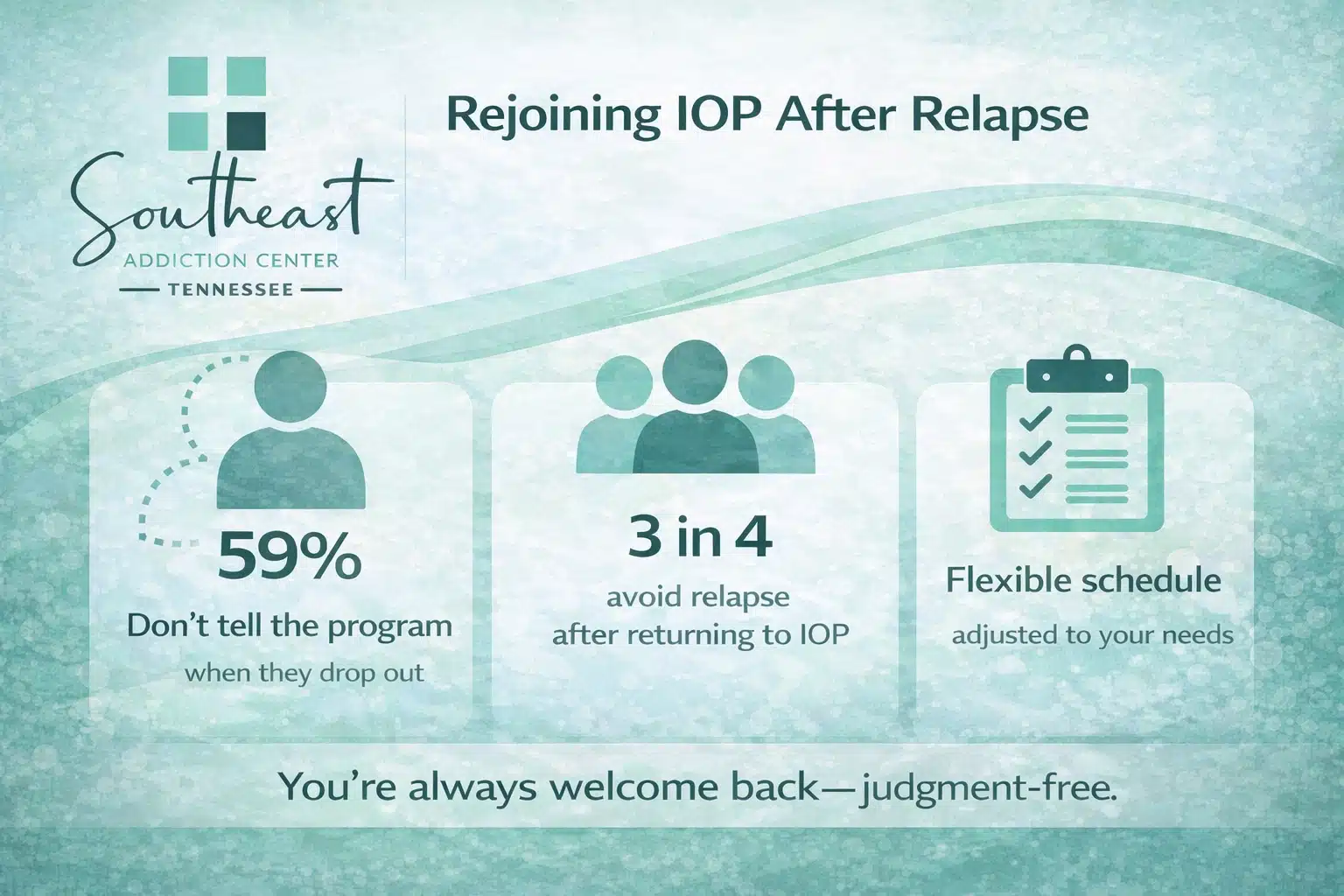
- Flexible scheduling to make re-engagement realistic, not overwhelming
Our Nashville-based team will walk with you, not ahead of you.
Quick Tips for Re-Engaging With IOP
- Let go of “shoulds.” You didn’t ruin anything. You’re here now.
- Lower the bar. A small step counts. Calling is courageous.
- Name one thing you miss. Group support? A safe space to talk? Let that guide your return.
- Bring your awkwardness. It’s okay if it feels weird. We expect that.
- Ask about alumni support. If IOP feels too big to restart, reconnecting through alumni pathways might be gentler.
A Final Word—From Someone Who’s Been There
“I thought they’d be mad. I thought I’d have to explain everything or apologize. But when I came back, they just said, ‘We’re glad you’re here.’ That was the moment I knew I could try again.”
– Former IOP Client, 2023
Ready to take that first step back?
Call us at (615) 326-6449 or visit Intensive Outpatient Program in Nashville, TN to learn more about our services.
No pressure. No shame. Just a door that’s still open.