

I remember the moment I realized something wasn’t right.
Not a dramatic moment. No big confession. Just small things that started stacking up.
They were sleeping all day. Avoiding conversations. Getting defensive over tiny questions. And every time I asked if they were okay, they said, “I’m fine.”
But something in my gut kept saying… they’re not fine.
If you’re reading this, you might be in that same place — stuck between doing nothing and doing everything. That confusing space where your child is technically an adult… but still so clearly struggling.
That’s when I first heard about something called a partial hospitalization program (PHP). And honestly? I didn’t fully understand what it meant at first.
When I First Heard About PHP
At the time, I thought treatment meant only two extremes:
- Weekly therapy that didn’t seem like enough
- Or full inpatient rehab that felt overwhelming and drastic
PHP turned out to be something in between.
For us, that mattered more than I expected.
They didn’t feel “locked away.”
And I didn’t feel like I was losing them completely.
It gave them real clinical support… while still keeping them connected to real life.
Why It Felt Different for My Young Adult
I kept asking myself:
“Is it bad enough for this level of care?”
But eventually, I realized the real question wasn’t about severity.
It was about sustainability.
Were things actually getting better?
Or were we just hoping they would?
That shift changed everything.
If your young adult:
- Keeps relapsing
- Struggles with motivation or emotional stability
- Pushes back against traditional therapy
- Just seems… stuck
You might be at that same crossroads we were.
And that doesn’t mean you failed as a parent.
It just means they may need more support than weekly therapy can provide.
What a Typical Day Started to Look Like
Before PHP, their days were unpredictable. Sleep schedules were chaotic. Motivation came and went. Emotions ruled everything.
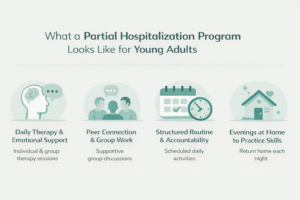
Once PHP started, there was rhythm again:
- Individual therapy
- Group sessions about coping and life skills
- Psychiatric check-ins
- Real conversations about relapse and mental health
- Structure that felt steady instead of chaotic
They weren’t just “getting through the day” anymore.
They were learning how to live it again.
The Hardest Part: When They Didn’t Want to Go
I won’t sugarcoat this — there were days they resisted.
Days they said it was pointless.
Days they insisted they didn’t need that much help.
But looking back, I realize something important:
Resistance didn’t mean the program wasn’t right.
It meant change was uncomfortable.
And for young adults especially, admitting they need help can feel like losing control — even when that help is exactly what gives them control back.
What I Didn’t Expect: How Much It Helped Me Too
One thing I didn’t anticipate was how involved families could be.
Not blamed. Not pushed aside.
Included.
We learned:
- How to communicate without escalating
- What emotional triggers looked like
- How to support recovery without enabling
It stopped feeling like I was fighting this battle alone.
What Happened After PHP
PHP wasn’t a magic fix.
But it was a turning point.
It gave my young adult:
- Emotional tools they didn’t have before
- A routine that supported sobriety
- A sense of accountability that didn’t feel forced
Most importantly, it gave them another chance — without shame attached to needing it.
If You’re Reading This as a Parent
I know how confusing this stage can be.
They’re not a child anymore…
But they’re not fully stable on their own yet either.
That in-between space is terrifying.
You don’t want to overreact.
You don’t want to underreact.
You just want to help.
A Partial Hospitalization Program isn’t about labeling your child as “severe” or “beyond help.” It’s about giving them the structure and support they might not yet know how to create for themselves.
And sometimes, that structure is the thing that finally helps everything shift.
You’re not overreacting for exploring more support.
You’re responding to what your gut has probably been telling you for a while now.
And you’re not alone in that feeling.
Call (615) 326-6449 or visit Southeast Addictions TN’s PHP page to speak with a clinician today. You’re not alone in this—and your child doesn’t have to face recovery alone either.
Let us help you take the next right step, one honest conversation at a time.